A lot of times I am getting asked "do I NEED to sand my pieces?"
Well, the answer can be yes and now. It all depends on what kind of surface technique you have used for your piece. If you have used any kind of mica powders or any other type of covering, like acrylic paint, metallic waxes, etc. of course, you definitely should NOT sand - sanding will remove your effects.
But if you used a normal veneer or any other type of surface that doesn't have anything applied to it, then yes.
The other question is "I am going to apply varnish/glaze/resin anyway, why do I need to sand?"
Well,
because even varnishes or glazes or even resin, do not look as good on
rough polymer clay as they do on sanded polymer clay. Certain effects -
like the mica shift based ones, for example - don't show their full
beauty until they are sanded.
As a side note, did you know that the mica shift technique was initially achieved by sanding the clay, not by shaving it?
So yes, you pretty much must sand. That is, if you want to have beautiful results.
Now, how exactly do you sand your pieces?
There are mandatory things to consider.
1. Always use the sandpaper type that can be used with water. You do not want to dry-sand polymer clay. The resulting dust is very fine and very damaging to your lungs if inhaled. Honestly, I use a mask even when I wet-sand.
2. Go gradually with increasing grits. Start with a 350-400, then go up increasing about 200-250 grit numbers. Like 400-600-800-1000. How high can you go? It's up to you, I personally go most of the time 2000 or 2500, but sometimes I may go as high as 3000 or 3500. It depends a lot on what you intend to do. If your intention is to varnish/glaze, 1000 and even 800 is enough. If you want to buff, the higher the grit you get to, the higher the gloss of your buff.
As for the point 2. Does it matter if you skip to a higher grit? Like from a 400 to a 2000? Again, it depends. Mostly on the polymer clay brand you've used. Some polymer clays get faster sanded than others. On most Premo, for example, the 2000 will definitely remove the scratches a 400 grits leaves on your clay. On Pardo though, it won't. Pardo is tougher so it needs a gradual sanding. Otherwise, if you go to a grit that is too high, it will not be able to remove those marks left by a lower grit sandpaper. It affects the look.
You can get higher grits of sandpaper either in the craft stores, or, better, in the auto-stores. Look in the automotive paint finishing isle. A lot of times you can even find there kits, with grits going from 400 to 2000.
Here's a small tutorial on how to sand (and buff) without spending a lot.
But, especially if you have arthritis in your hands (and even if not), your hands might start hurting if you do a lot of sanding on your pieces.
After the disappointment with PolyFast, I kept looking for a solution that would allow me to sand without hurting my hands too much. And I found it.
First, you need a pedicure wand. Why pedicure wand and not something else, like an electric nail file, or defoliator, etc? Simply because the electric nail files are usually quite flimsy and pretty much made out of plastic, and, they're mostly cordless, so here you get again an insane amount spent on batteries. The corded ones are quite pricey.
Also, a pedicure wand doesn't rotate at insane speeds like a dremel, so there's no danger of gouging your polymer clay piece. So this is VERY IMPORTANT!
As much as it is possible to buy an adapter to use the piece that comes with the sanding disks on a dremel, do NOT use a dremel to sand polymer clay. Unless you have a supremely steady hand and perfect control, due to the high speed rotation, it will EAT UP your polymer clay. That is the reason the pedicure wand is needed.
So, in my search to find the perfect one, I looked for one that would have 3 qualities:
1. be made out of metal,
2. be corded and
3. be of a decent price.
Of
course, there were some less major points I was looking for, i.e. be
relatively small so it wouldn't tire my hands. The fact that the pad is
almost 2" also helps.
This is the one I chose:
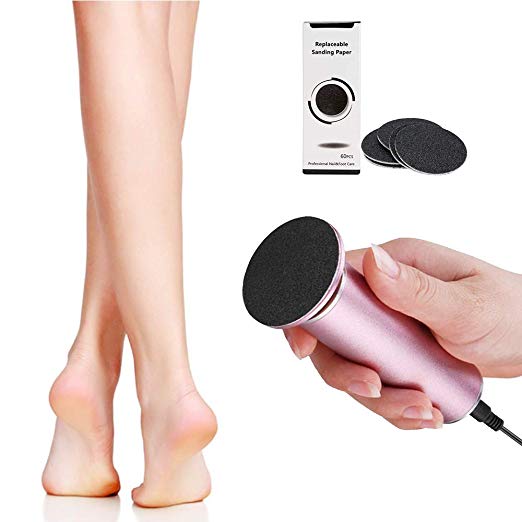

I bought them from Amazon USA HERE.
Again,
for people in Europe and other continents who can't buy from USA
Amazon, I found these too on Aliexpress, only that the set that has the
foam pad has less grits and can be found HERE but you can buy more discs of various grits HERE
For UK people I found it on Amazon UK HERE
Amazon Germany you can find the kit HERE
You can purchase them both from my Amazon Influencer store, in the "sanding" section of the store. Just click HERE.

No comments:
Post a Comment